




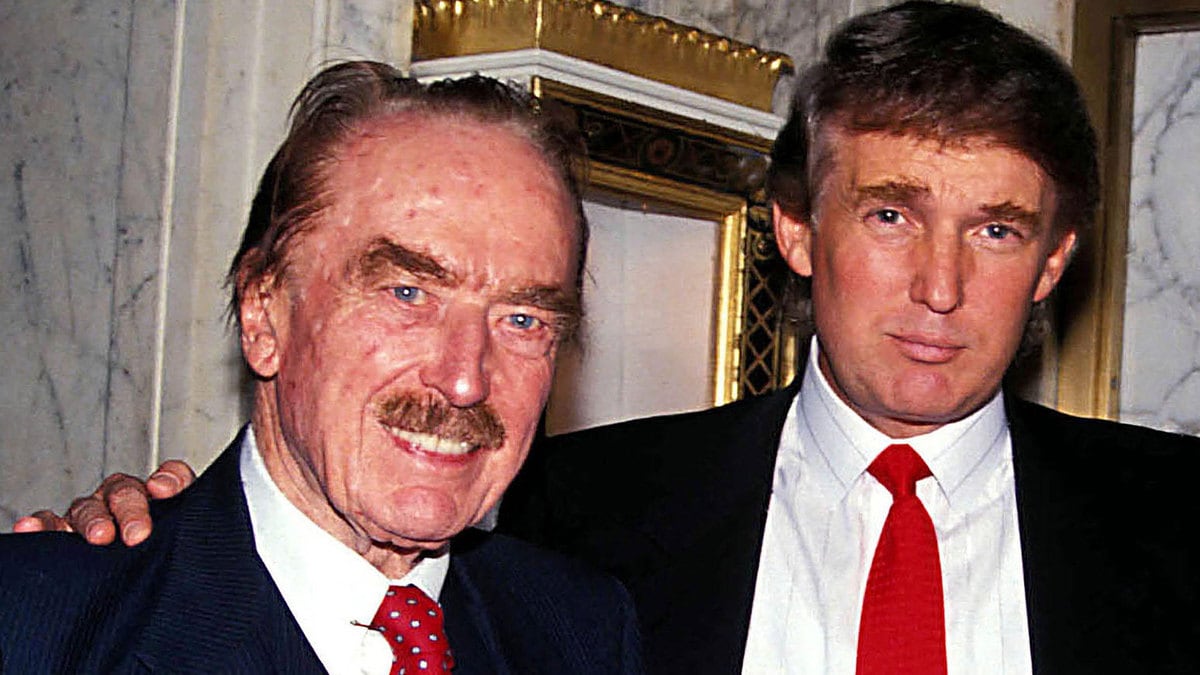
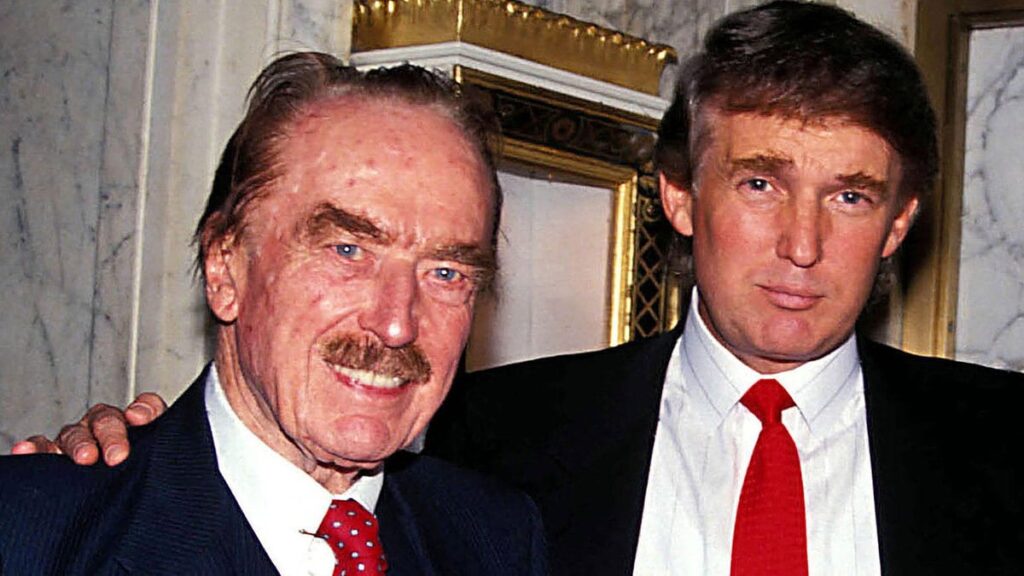
Trump’s father, the German-born Frederick Trump (originally Friedrich), amassed considerable wealth during the Klondike Gold Rush by running a restaurant and brothel for miners. Friedrich returned to Kallstadt in 1901, and, by the next year, met and married Elizabeth Christ.
They moved to New York City, where their first child, Elizabeth, was born in 1904. Later that year, the family returned to Kallstadt.Fred was conceived in Bavaria, where his parents wished tore-establish residency, but Friedrich was banished for dodging the draft.
The family returned to New York on July 1, 1905, and moved to the Bronx, where Frederick Christ Trump was born on October 11. Fred’s younger brother, John G. Trump, was born in 1907.
All three children were raised speaking German at home.In September 1908, the family moved to Woodhaven, Queens. Many details of Trump’s childhood come from autobiographical accounts and emphasize independence, learning and especially hard work – to the point of being somewhat fictionalized.
At the age of 10, Trump worked as a delivery boy for a butcher.About two years later, on Memorial Day, his father died in the 1918 flu pandemic, quite suddenly according to Fred. From 1918 to 1923, Fred attended Richmond Hill High School in Queens, while working as a caddy, curb whitewasher, delivery boy, and newspaper hawker.Meanwhile, his mother continued the real-estate business Friedrich had begun.
Interested in becoming a builder, Fred put up a garage for a neighbor and took night classes in carpentry and reading blueprints; he reputedly studied plumbing, masonry, and electrical wiring via correspondence courses, although other biographical sources limit his construction education to the period after high school when he was also working in the field.
After graduating in January 1923, Trump obtained full-time work pulling lumber to construction sites.He studied carpentry and became a carpenter’s assistant.Trump’s mother held the business in her name until he reached 21, the age of majority.
The company name “E. Trump & Son” appeared in advertising by 1924, by which year Trump ostensibly used an $800 loan from his mother to complete and sell his first house. Public records, however, do not support him building until 1927, the year the company was incorporated(and following Trump’s 21st birthday).
Trump purportedly built 19 more homes by 1926 in Hollis, Queens, selling some before they were finished to finance others. Investigative journalist Wayne Barrett posits that Trump exaggerated the length of his career while arguing in federal court in 1934 that he should deserve a dissolved company’s mortgage servicer. In 1927, Trump was arrested at a Ku Klux Klan demonstration, although there is no conclusive evidence that he supported the organization.
Rise to successIn 1933,
Trump built one of New York City’s first modern supermarkets, called Trump Market, in Woodhaven, Queens. It was modeled on Long Island’s King Kullen, a self-service supermarket chain. Trump’s store advertised “Serve Yourself and Save!” and quickly became popular. After six months, Trump sold it to King Kullen.
In federal court in 1934, Trump and a partner acquired the mortgage-servicing subsidiary of Brooklyn’s J. Lehrenkrauss Corporation, which had gone bankrupt and had subsequently been broken up. This gave Trump access to the titles of many properties nearing foreclosure, which he bought at low cost and sold at a profit. This and similar real-estate ventures quickly brought him fame as one of New York City’s most successful businessmen.
Trump made use of loan subsidies created by the Federal Housing Administration (FHA) not long after the program was initiated via the National Housing Act of 1934,which also enabled the discriminatory practice of redlining.
By 1936, Trump had 400 workers[i] digging foundations for houses that would be sold at prices ranging from $3,000 to $6,250.Trump used his father’s psychological tactic of listing properties at prices ending in “… 9.99”. In the late 1930s, he used a boat to advertise off Coney Island’s shore; it played patriotic music and floated out swordfish-shaped balloons which could be redeemed for $25 or $250 towards one of his properties.
In 1938, the Brooklyn Daily Eagle referred to Trump as “the Henry Ford of the home building industry”. During this period, Trump predicted that he would profit from World War II. By 1942, he had built 2,000 homes in Brooklyn using FHA funds.During the war, the federal Office of Production Management (established in 1941) allowed the use of FHA funding for defense housing in Bensonhurst, Brooklyn, owing to the proximity of the Brooklyn Navy Yard.
Trump planned to build 700 houses there, which would have been both his and the state FHA office’s biggest project to date, but following the attack on Pearl Harbor and the United States’s declaration of war on Japan, the project was dissolved in favor of defense housing at the East Coast’s naval nexus, Hampton Roads by Norfolk, Virginia, where Trump was already working on an apartment complex.
Congress added a provision to the National Housing Act generating mortgage insurance for defense apartments, through which Trump was allowed to own the properties he built for war workers.
By 1944, he had constructed 1,360 wartime apartments, almost 10% of the total created in Norfolk.He also built barracks and garden apartments for U.S. Navy personnel near major shipyards in Norfolk and Newport News, Virginia, as well as Chester, Pennsylvania.
Following the war, Trump expanded into middle-income housing for the families of returning veterans. From 1947 to 1949, he built Shore Haven in Bensonhurst, which included 32 six-story buildings and a shopping center, covering some 30 acres (12 hectares) and procuring him $9 million in FHA funding.
In 1950, he built the 23-building Beach Haven Apartments over 40 acres (16 ha) near Coney Island, procuring him $16 million in FHA funds.The total number of apartments included in these projects exceeded 2,700. Decades after hiring PR man Howard Rubenstein to generate press about his life story mirroring the rags-to-riches novels of 19th-century author Horatio Alger, in 1985, Fred was awarded the Horatio Alger Award (for “distinguished Americans”).
Radio and television personality Art Linkletter introduced Trump at the ceremony, with Peale’s wife (and previous award recipient), Ruth Peale, presenting him the award. During his speech, Trump stated that the key to his success was enthusiasm for his work and that he “used to watch other successful people … that did good and that did bad and … followed the good qualities that they had”.
He then (apparently erroneously) attributed to William Shakespeare the saying “Never follow an empty wagon because”, pointing to his cranium, “nothing ever falls off”. He went on to introduce his surviving nuclear family.