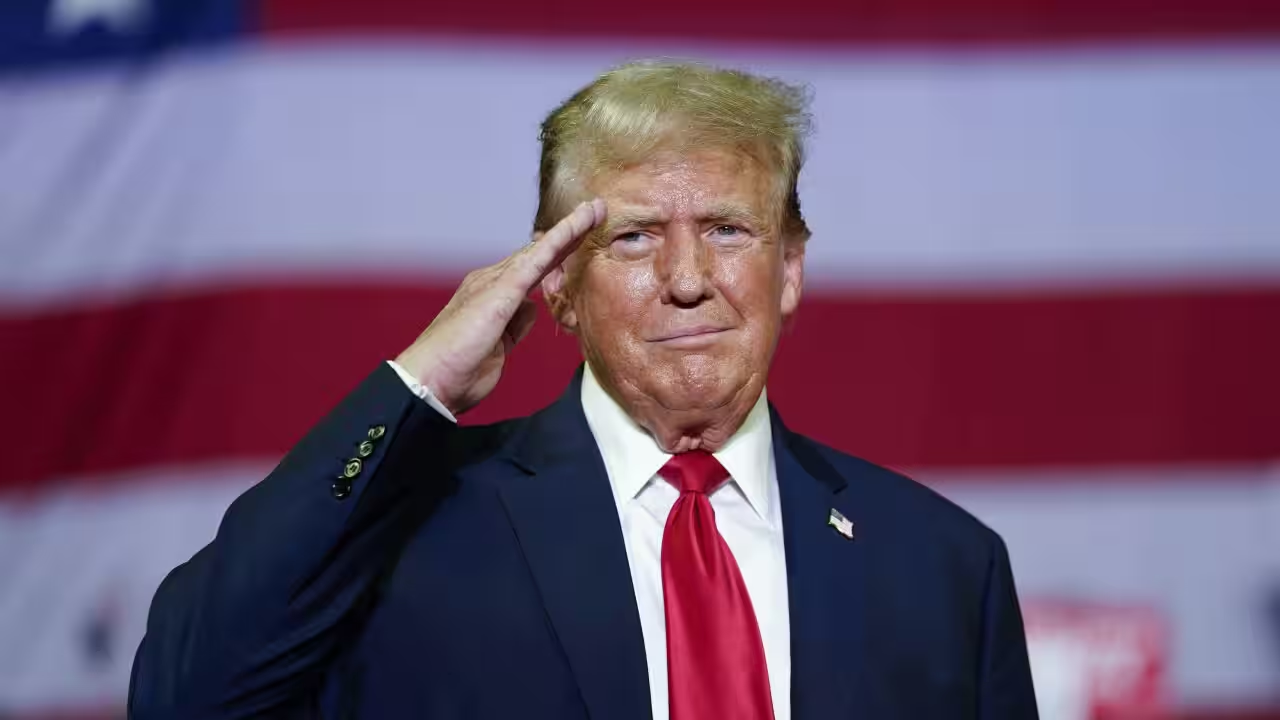



Donald John Trump was born on June 14, 1946, at Jamaica Hospital in the New York City borough of Queens, the fourth child of Fred Trump and Mary Anne MacLeod Trump. He is of German and Scottish descent.He grew up with his older siblings, Maryanne, Fred Jr., and Elizabeth, and his younger brother, Robert, in a mansion in the Jamaica Estates neighborhood of Queens. Fred Trump paid his children each about $20,000 a year, equivalent to $265,000 a year in 2024. Trump was a millionaire in inflation-adjusted dollars by age eight.
Trump attended the private Kew-Forest School through seventh grade. He was a difficult child and showed an early interest in his father’s business. His father enrolled him in New York Military Academy, a private boarding school, to complete secondary school. The academy pushed students into sports.and drilled the imperative of winning
Trump considered a show business career but instead, to be closer to home, enrolled at Fordham University in 1964. He dropped ROTC officer training after one year,and played indifferent football, squash, and tennis. His Fordham friends introduced him to golf.His junior year he transferred to the Wharton School of the University of Pennsylvania, most often commuting to his father’s office on weekends, and graduating in May 1968 with a Bachelor of Science in economics.
In college he was not the top student he sometimes claimed to be.By the time he went to Wharton—where he does not appear in a list of those receiving honors.he was eyeing a career in real estate. He was exempted from the draft during the Vietnam War due to a claim of bone spurs in his heels.Notwithstanding five years in military school,he had no interest in going to war.Growing up, he considered his father and the family’s pastor, Norman Vincent Peale, to be his mentors. His father told him repeatedly that he was “a king”.Peale preached self-confidence as the impetus for prosperity.
Business Career
Starting in 1968, Trump was employed at Trump Management, his father’s real estate company, which managed the middle-class apartment complexes Fred had built in Queens, Staten Island, and Brooklyn. His main tasks were collecting rent and making repairs for about five years. Captivated by its glamor and riches, Trump asked his father to expand to Manhattan where prices were at least three orders of magnitude higher, but his father was content in theouter boroughs.In 1971, he moved to Manhattan where he planned to move the business and commuted to his father’s office. That year, his father made himself chairman and Trump president, overseeing 48 private corporations and 15 family partnerships. Trump renamed the disparate businesses to a single umbrella, the Trump Organization.
Roy Cohn, Trump’s most important early influence after his father,was his fixer, lawyer, and mentor for 13 years in the 1970s and 1980s.Cohn taught Trump to think that life is transactional. In 1973, Cohn helped Trump countersue the U.S. government for $100 million (equivalent to $708 million in 2024over its charges that Trump’s properties had discriminated against Black applicants and tenants.
Trump’s counterclaims were dismissed, and the government’s case was settled with the Trumps signing a consent decree agreeing to desegregate. Four years later, the Trumps again faced the courts when they were found in contempt of the decree.
Helping Trump projects,Cohn was a consigliere whose Mafia connections controlled construction unions. In 1979, Cohn introduced political consultant Roger Stone to Trump, who enlisted Stone’s services to deal with the federal government.
Trump moved from his studio to a penthouse with a view and got a real estate broker’s license in the mid-1970s. Before age thirty, he showed his propensity for litigation, no matter the outcome and cost; even when he lost, he described the case as a win.
Over three decades as of 2018, Trump had been involved in more than 4,000 lawsuits,liens, and other filings, often filed for nonpayment against him by employees, contractors, real estate brokers, and his own attorneys. Between 1991 and 2009, Trump filed for Chapter 11 bankruptcy protection for six of his businesses: the Plaza Hotel in Manhattan, the casinos in Atlantic City, New Jersey, and the Trump Hotels & Casino Resorts company.
In 1992, Trump, his siblings Maryanne, Elizabeth, and Robert, and his cousin John W. Walter formed All County Building Supply & Maintenance Corp, each with a 20 percent share. The company had no offices and is alleged to have been a shell company for paying the vendors providing services and supplies for Trump’s rental units, then billing those services and supplies to Trump Management with markups of 20–50 percent and more.
The owners shared the proceeds generated by the markups. The increased costs were used to get state approval for increasing the rents of his rent-stabilized units. In January 1994, the siblings formed Apartment Management Associates and took over the management fees formerly collected by Trump Management. As well as inflating rents, the schemes served to transfer assets from Fred Trump to his children and nephew and lower the tax burden.